
Workforce operations
Digitizing the Hospital Employee Lifecycle Without Losing Context
Map the handoffs before choosing the software. Identify who supplies information, who reviews it and what the next team needs across recruitment, induction, daily workforce tasks and departure. This guide outlines planning questions and connects readers to GanpatrAI’s eight live modules without implying that every module is automatically integrated.
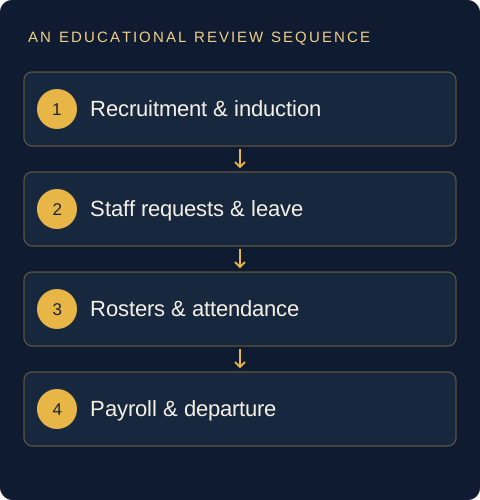
Map the current employee journey
Begin with a person’s journey through the institution and the work each team performs. Recruitment, induction, everyday requests, schedules, attendance, payroll and departure each involve information that someone else may need. The useful question is not just which screen exists, but what triggers the next team’s work.
Draw the current route before designing the digital one. Include an exception path: what happens if a request is incomplete, a reviewer is absent or two teams disagree about the current record? This article offers planning questions, not a claim that a single system already connects every stage.
Identify owners and repeated handoffs
For each handoff, identify the sender, recipient, minimum information, approval state and acknowledgement. Separate ownership of a record from permission to view it. A payroll team may need a reviewed change without needing all the background correspondence that led to it.
Start with one clearly defined workflow
Choose a bounded workflow whose start, end and reviewer can be stated clearly. For example, evaluate how a leave request reaches the appropriate reviewer before attempting a whole employee-lifecycle rollout. Define the evidence that would make the evaluation useful, including what happens when the request is returned.
The GAO’s 2025 internal-control framework includes documenting risk and significant change assessments. Used as a general reference rather than Indian law, it reinforces the value of recording why a process changes and who reviews the result. [source]
Link requests, schedules and review context
Confirm interfaces rather than assuming integration
Ask what is transferred, in which direction, how often and how a failed transfer becomes visible. Confirm who resolves conflicts when two systems hold different values. A link between pages, a common company logo or similar field names does not establish a supported software interface.
Where work remains manual, document it plainly. A controlled manual handoff can be evaluated on its own terms; describing it as automatic makes responsibility harder to understand. Request product evidence before publishing any integration claim.
Plan payroll and departure boundaries
Identify when a change is approved for payroll use and which unresolved issues should stay outside the calculation or release process. During departure, distinguish resignation, departmental clearance and any payroll or final-settlement work. Define the responsible team for each, without assuming that one completed stage closes every other responsibility.
Consider access and record ownership when an employee changes role or leaves. Ask the relevant privacy and security owners which access changes and retention rules apply. This guide prescribes no universal retention period or settlement deadline.
Agree evidence for a phased evaluation
- Can staff identify the correct place to make a request?
- Can the reviewer identify the source and approval state of the information?
- Can an incomplete handoff be found and assigned to an owner?
- Are the supported interfaces and remaining manual steps documented?
- Is the next stage contingent on evidence rather than an assumed benefit?
GanpatrAI has eight live modules, linked below. Confirm each module’s scope and any connection between them in a guided demo. The induction guide and payroll evaluation guide provide more detailed questions for those handoffs. No customer transformation, saving or end-to-end automation outcome is asserted here.
Sources and scope
The cited publications support the specific statements linked above. Checklists and fictional examples are editorial proposals for review, not requirements imposed by these sources.
- US GAO — Standards for Internal Control in the Federal Government, GAO-25-107721, 2025
General reference on preventive controls, management responsibility and documenting risk/change; not Indian payroll law.