
Learning and employee experience
Designing a Clear Employee Induction Journey in Healthcare
A clear induction journey tells employees what to learn, how to complete each step and where to ask for help. Plan the sequence around their role and distinguish participation, knowledge checks and practical assessment. This guide offers an editorial framework; it does not treat a screenshot or quiz as proof of identity or competence.
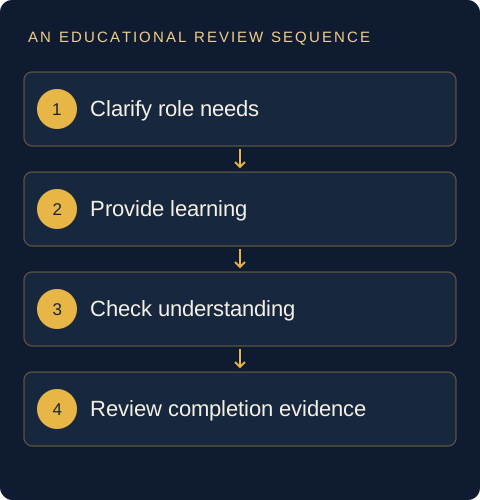
Define learning needs for each role
Start with the employee’s role and the information needed to begin work with appropriate supervision and support. List the learning objective, responsible educator and expected evidence for each topic. A long list of presentations is not yet an induction design: it needs a sequence and a clear account of what each activity is meant to establish.
WHO’s 2022 competency and outcomes framework links education outcomes with curricula, learning activities and assessment. It provides an educational reference; it does not prescribe an induction schedule for your institution. [source]
Separate institution-wide and department-specific content
Distinguish shared orientation, such as where to find institutional procedures, from department-specific learning. Ask a responsible local educator to define the relevant requirements rather than reusing another department’s checklist unchanged. Identify which material is informational and which task needs supervised practice or a separate assessment.
Design a visible sequence and support route
Tell the employee what to do first, what follows and whom to contact when a step cannot be completed. Make the instructions usable for staff working different shifts. Confirm access methods and an alternative support route where a person cannot use the normal interface.
Choose clear status labels. “Assigned”, “started”, “submitted” and “reviewed” describe different events. Decide who records each event and what it means. A completion indicator should point to the evidence required by the institution rather than hide unfinished activity behind a single label.
Use knowledge checks for understanding
A question should test the learning objective, not merely recall a slide’s wording. Explain how feedback is provided and what happens after an incorrect answer. An employee who remains unsure should have a route to an educator or supervisor; repeated clicking should not be treated as evidence that the underlying question is resolved.
Distinguish completion from competency
Review incomplete steps and improve content
Review outstanding steps by reason: access problem, unavailable session, unanswered question or an assessment awaiting review. These are different follow-up tasks. Agree an owner and next action rather than treating every incomplete item as employee non-participation.
When instructions change, identify the content version and decide who needs an update. Keep the original record meaningful: a later version should not make it appear that a person completed material they never received. This is a proposed record-design consideration, not a claim about any particular software.
Questions to ask during an induction-module demo
- What can be assigned, and to whom?
- What is recorded when an employee starts, answers or completes a step?
- Who can review incomplete work and provide support?
- How are material changes distinguished from earlier content?
- Which identity, assessment and reporting functions are actually supported?
GanpatrAI’s Induction & Training page links to a four-stage public illustration. The supplied portrait in that illustration is not evidence of biometric verification or proctoring. Consult Training Records and Competency before combining learning evidence into a report, and consider Self-Service when discussing how employees access routine HR information. This guide makes no accreditation or clinical-outcome claim.
Sources and scope
The cited publications support the specific statements linked above. Checklists and fictional examples are editorial proposals for review, not requirements imposed by these sources.
- WHO — Global Competency and Outcomes Framework for Universal Health Coverage, 2022
Alignment of education outcomes, learning activities and assessment; not an accreditation checklist for this institution.