
AI and governance
Responsible AI in Healthcare HR: A Practical Review Framework
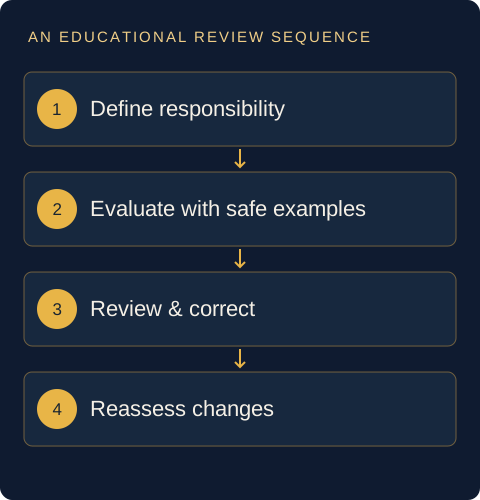
Responsible evaluation starts with a defined task and an accountable human owner. Decide what data is appropriate, how outputs will be checked and how errors can be corrected. This guide proposes review questions for healthcare HR teams; it is not a certification framework or a claim that GanpatrAI meets every control described.
Specify the task and decision boundary
Write a short task statement: the problem, intended users, information used, expected output and decision owner. Identify uses that are outside the evaluation. A boundary such as “organise information for review” should specify what the reviewer checks before anything influences recruitment, attendance or payroll.
NIST AI RMF 1.0 organises risk work around governance, context, measurement and management. Use it as a voluntary reference, not as a certificate or a statement of Indian legal compliance. [source]
Keep consequential decisions accountable
Give the responsible person time, access to source information and authority to question an output. A named reviewer who cannot examine or change anything is an incomplete control. Specify what happens when an output cannot be explained or is unsuitable for the task.
Review data necessity and access
Map the information from collection through use, sharing and eventual disposal. For each field, ask why it is required, who can access it and which service receives it. Check whether diagnostic logs, exports or support requests create additional copies. Avoid assuming that a deployment label, including “on-premise”, answers every data-flow question.
The DPDP Act commencement notification dated 13 November 2025 and rule 1 of the 2025 Rules specify staged commencement. Do not treat the existence of a notified framework as evidence that every provision began simultaneously. Check the current official notifications, amendments and applicability with a qualified adviser before setting an institution’s legal position. [source] [source] This guide is operational education, not legal advice or a compliance assessment.
Test outputs on approved examples
Choose fictional cases that reflect the kinds of uncertainty the team needs to handle. Agree the expected response and who judges it. Include missing inputs and contradictions, not only straightforward cases. Keep the test record separate from real employee decisions, and limit access to the people evaluating the system.
Examine error cases and limitations
Plan correction and escalation
Agree how users report an error, who assesses it and when use should pause. Establish a route to correct downstream material already affected by the output. Keep an accountable owner for the unresolved issue rather than treating the presence of a support inbox as sufficient.
- What information is needed to reproduce the issue safely?
- Who can stop an inappropriate output from being used?
- What correction reaches the affected reviewer or employee?
- What evidence is needed before normal use resumes?
Document the scope of a pilot and review changes
Record the tasks, users, permitted data, evidence to collect and review decision for a pilot. Revisit that scope when the model, configuration, input source or intended use changes. Do not extend a successful small demonstration into an unsupported promise about every department or population.
Use the recruitment evaluation guide for a task-specific example. GanpatrAI’s AI Recruitment, Biometric Anomaly Audit and Payroll & Compliance pages describe public scope; they do not establish every control discussed here. Any legal, security or professional assurance requires its own evidence and appropriate review.
Sources and scope
The cited publications support the specific statements linked above. Checklists and fictional examples are editorial proposals for review, not requirements imposed by these sources.
- NIST — Artificial Intelligence Risk Management Framework (AI RMF 1.0), January 2023
Voluntary risk-management context, accountability and evaluation; not Indian law or product certification.
- MeitY — DPDP Act commencement notification, G.S.R. 843(E), 13 November 2025
Historical notification with staged commencement for specified Act provisions; current applicability requires checking subsequent notifications.
- MeitY — Digital Personal Data Protection Rules, 2025, G.S.R. 846(E), rule 1
Rule 1 commencement structure; not a complete legal interpretation of duties, exemptions or later amendments.