
AI and governance
AI in Hospital Recruitment: A Human-Reviewed Workflow
Begin with the recruitment task, not the AI label. Define the information needed, the output expected and the person responsible for reviewing it. This guide proposes an evaluation framework for hospital recruitment teams; it does not claim that GanpatrAI performs each example task.
Define the recruitment problem before choosing a tool
A hospital recruitment requirement is more useful than a broad request to “add AI”. Describe the bottleneck in operational terms: perhaps reviewers cannot find a stated qualification in varied document formats, or candidate correspondence is inconsistent. Decide what a satisfactory output would look like before comparing tools.
Record the task owner, the information used and the consequence of an incorrect result. NIST’s AI RMF 1.0 is a voluntary framework for considering AI risks and trustworthiness; it is not a hiring-law checklist or a certification of a particular tool. [source]
Separate administrative assistance from selection decisions
Organising information, drafting correspondence and deciding who should be appointed are different activities. In a procurement discussion, ask which task is being demonstrated. Keep the approved selection criteria and the person authorised to make a decision explicit. Calling a step “assistance” does not explain its influence on the final decision.
Map inputs, outputs and human review
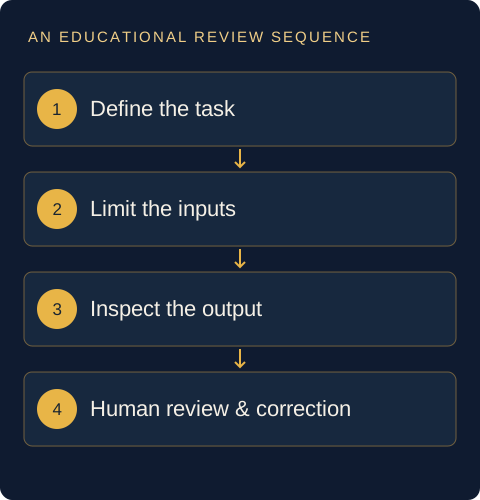
Create a simple record for each proposed use: input, generated output, required reviewer, correction route and downstream action. A reviewer should know whether they are examining original evidence or a software-generated interpretation. Ask what happens when the source document is incomplete, unreadable or contradictory.
Consider how an incorrect output is stopped from moving into an interview pack or a communication. A warning that nobody sees is not a practical correction process.
Check what candidate information is necessary
For a test, use approved fictional records and the smallest information set needed to evaluate the task. Ask why every requested field is necessary. Avoid uploading real candidate documents to an unapproved service merely to make a demonstration realistic. Clarify access, storage, deletion and provider use of submitted information before a pilot.
Evaluate errors, consistency and explanations
Prepare an evaluation sheet before the vendor presentation. Record the expected result, observed result, missing information and explanation supplied. Include cases where the appropriate response is to ask for clarification. Do not treat a fluent summary or a precise-looking score as proof that the underlying evidence is correct.
NIST identifies reliability, transparency and management of harmful bias among the dimensions of trustworthy AI. These require evaluation in context; an “AI-enabled” label is not evidence of bias-free recruitment. [source]
Use approved fictional evaluation cases
Questions to ask a software provider
- Which recruitment task is supported, and which decisions remain outside the tool?
- Can the reviewer trace a statement back to the input?
- How are unsupported or uncertain conclusions displayed?
- Who can correct the output, and is the correction retained where needed?
- What evidence describes limitations for the intended roles and document types?
Ask the provider to demonstrate an unsuccessful case as well as a polished example. Keep unanswered questions in the evaluation record rather than treating them as implied capabilities.
What a guided product demonstration should establish
Leave the demo with a written scope: supported inputs, assistance, outputs, human decision points and limitations. Agree the conditions for a small evaluation and who can stop it. This guide does not establish autonomous ranking, scoring or selection as a GanpatrAI capability.
The AI Recruitment solution page describes the confirmed public scope. Use the responsible-AI review framework to extend the conversation to ownership, data and correction. Obtain appropriate specialist advice before translating evaluation questions into employment or privacy policy.
Sources and scope
The cited publications support the specific statements linked above. Checklists and fictional examples are editorial proposals for review, not requirements imposed by these sources.
- NIST — Artificial Intelligence Risk Management Framework (AI RMF 1.0), January 2023
Voluntary risk-management context, accountability and evaluation; not Indian law or product certification.