
Workforce operations
Attendance Anomaly Review: Context Before Conclusions
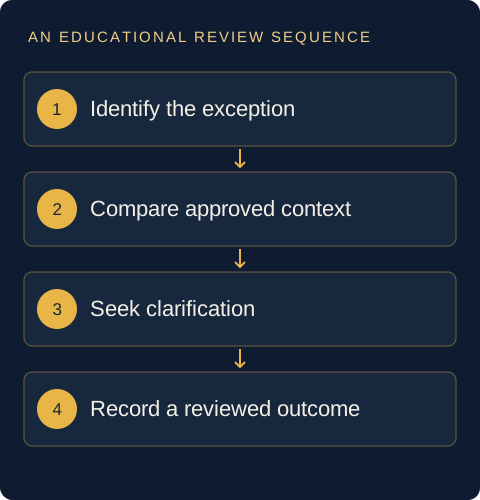
Treat an attendance exception as a question to investigate. Compare the record with the relevant schedule and approved context, then record the review outcome. A missing or unusual record does not by itself establish misconduct. This guide explains a review approach, not the detection rules or outputs of any unverified product feature.
Define what an exception means
Define an exception as a record that does not match an expected condition and therefore needs review. Write down that condition before interpreting the result. A label such as “missing record” should identify what is absent, which period is affected and which comparison produced the label.
The US GAO’s 2025 internal-control framework emphasises documented risk assessment and management responsibility. It offers a general control reference, not an Indian employment-law standard or a biometric accuracy benchmark. [source]
Separate missing information from conflicting records
A missing event and two conflicting events require different questions. For a missing event, ask whether the relevant source is complete. For a conflict, identify the records and their provenance. Avoid replacing a precise factual description with a conclusion such as “fraud”, “absence” or “intentional manipulation” before the appropriate review.
Compare the record with approved context
Establish which roster version and approved changes applied to the period. Confirm that the record belongs to the intended person and that the dates and time conventions are understood. Where an event crosses midnight, clarify how the local process assigns it to a shift; do not quietly force it into a calendar-day assumption.
Keep the original information available to the authorised reviewer. If a report is incomplete, record that limitation. A spreadsheet export may be a useful working view, but it should not silently become the only evidence of what was recorded.
Give the appropriate reviewer responsibility
Separate responsibility for gathering information from authority to decide its effect. An attendance administrator may identify an exception, while another authorised reviewer determines whether a correction is justified. State the review route and the evidence required by institutional policy. Do not give every user permission to change a record simply because they can view a report.
Seek clarification before drawing conclusions
Record outcomes and corrections
Use a review record that distinguishes the original observation, evidence considered, decision, reviewer and any authorised correction. Where evidence is insufficient, record the next action and its owner. Do not make unresolved cases disappear merely to produce a clean summary.
- Retain a reference to the source record.
- State why a correction was accepted or declined.
- Identify whether a downstream team needs a reviewed update.
- Limit access to those with a relevant role.
Retention periods, employee representations and disciplinary requirements are not prescribed here. They require current policy and qualified advice for the relevant institution.
Evaluate reports and audit-trail requirements
Ask to see how a system distinguishes a flagged exception from a reviewed outcome, and which reports or exports actually exist. Confirm the meaning of each status and whether original and corrected records can be distinguished. Treat these as evaluation questions rather than assumed features.
The Biometric Anomaly Audit page presents GanpatrAI’s approved public illustration. Compare it with Shift Rostering and the responsible-AI review framework when discussing sources, limitations and human responsibility. No device accuracy, misconduct-detection or automatic payroll-adjustment claim is made.
Sources and scope
The cited publications support the specific statements linked above. Checklists and fictional examples are editorial proposals for review, not requirements imposed by these sources.
- US GAO — Standards for Internal Control in the Federal Government, GAO-25-107721, 2025
General reference on preventive controls, management responsibility and documenting risk/change; not Indian payroll law.